


Responsibility is a cornerstone of personal development and healthy relationships. It involves more than simply completing tasks; it encompasses owning up to our actions, learning from mistakes, and consistently demonstrating reliability.
In this blog post, we’ll delve into the importance of taking responsibility and outline practical steps to cultivate it in our day-to-day lives. We’ll also highlight the nuanced difference between taking responsibility and taking accountability.
Why talk about taking responsibility?
Taking responsibility is the difference between a powerful individual, who is in control of their life and a powerless individual who isn’t accountable for anything and lives out of control in their life.
If you want to be more self-confident in your life, I encourage you to fully take on focusing on taking responsibility in your life!
Jump To Section:
Responsibility and Accountability is There a Difference?
The 3 Causes of Irresponsibility
Why Taking Responsibility Feels So Hard
Taking Responsibility Is a Power Move
7 Steps to Taking Responsibility in Your Life
Reflect, and Extract Your Lesson
How to Apologize Once You’ve Taken Responsibility
Building Trust Through Responsibility
Dealing With Irresponsibility in Relationships
Responsibility and Accountability is There a Difference?
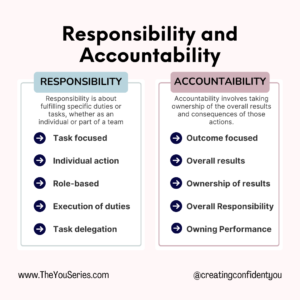 While responsibility and accountability are often used interchangeably, they carry distinct meanings.
- Responsibility refers to the tasks or duties one is expected to perform. It’s about fulfilling commitments and doing what is expected of us.
- Accountability, on the other hand, takes responsibility a step further. It involves accepting the consequences, whether positive or negative, for the outcomes of those responsibilities. Accountability goes beyond just fulfilling tasks; it involves owning the results and taking responsibility for them.
Taking responsibility and taking accountability are both important qualities, and ideally, a person should possess both. They’re skill that you want to have to progress in your work life, relationships and community.
While they are related, they play distinct roles in personal and professional development.
The 3 Causes Of Irresponsibility:
I’m a firm believer that if we want to do better at something, first we must know what sets us back. Here are the 3 core things that stop anyone from taking responsibility. We’ve all done this at some in our lives. These are some of the ways that human beings tend to avoid taking responsibility in life.
1. Blaming others:
it’s never my fault. Someone else did it. Choosing to take no responsibility for your contribution. Often times people who are focused on blaming others, are insecure & never satisfied in their life.
2. Excuses:
Someone of something else stopped me for making it happen. Excuses have a lot of control over us. When we use excuses we have no control over ourselves.
3. Complaining:
Being dissatisfied about an experience that we most likely got ourselves into. You act as if someone forced you to do it but nobody forces you to do anything. Taking responsibility will allow you to see how you get into these situations you don’t desire. Sometimes you’ll sign up to attend an event. Then you’ll regret having to go as if someone forced you to go. Stop complaining about the thing and start to find solutions. What can you learn from the actions that you’ve taken in the past?
Pay attention to what you say, you’ll notice new patterns and ways of being that stop you from taking responsibility for things in your life.
They leave you feeling powerless, weak & out of control. Nobody does this to you as you do it to yourself.
Why Taking Responsibility Feels So Hard:
Taking responsibility sounds simple in theory, but in reality, it can feel incredibly uncomfortable.
For many people, taking responsibility does not just feel like admitting they made a mistake. Deep down, it can feel like admitting they are flawed, rejected, unworthy, or “bad.”
That is why defensiveness can show up so quickly. And truly those who don’t understanding the power of radical responsibility do get defensive.
When someone grows up in an environment where mistakes were met with:
- shame
- criticism
- guilt
- blame
- emotional withdrawal
- punishment
They often learn to protect themselves at all costs. Instead of seeing accountability as something healthy, it starts to feel threatening. I talk about this in my article about unhealthy family dynamics.
Sometimes people avoid responsibility because:
- their ego feels attacked
- they fear rejection or abandonment
- they never learned healthy emotional regulation
- they learned to survive through defensiveness
- admitting fault feels emotionally unsafe
- they confuse accountability with shame
- they tie their identity to being “right” or “good”
For some people, hearing:
“You hurt me”
internally feels more like:
“You are a terrible person.”
That emotional reaction can quickly trigger excuses, blame-shifting, defensiveness, denial, or emotional shutdown.
Emotionally immature environments can reinforce these patterns too. If someone grew up around people who avoided difficult conversations, blamed others, exploded emotionally, or swept issues under the rug, responsibility may never have been modeled in a healthy way.
But true responsibility is not about tearing yourself apart or carrying endless shame.
It is about developing enough self-awareness and emotional security to say:
“Yes, I made a mistake. But I am capable of learning, growing, and doing better.”
That is strength.
Taking Responsibility Is a Power Move:
A lot of people see responsibility as weakness because it requires vulnerability.
It requires someone to pause, reflect, and admit:
“Okay… maybe I could have handled that better.”
But honestly, taking responsibility is one of the most powerful things a person can do.
Why?
Because the moment you stop blaming everyone else for your reactions, your choices, your patterns, or your life circumstances… you stop giving your power away too.
People who avoid responsibility often stay stuck in the same cycles:
- the same arguments
- the same unhealthy habits
- the same relationship patterns
- the same emotional reactions
Not because they are incapable of change, but because real change requires self-awareness.
Responsibility is what allows growth to happen.
It sounds like:
“I may not control everything that happens to me, but I can take ownership of how I respond.”
That mindset changes everything.
Taking responsibility does not mean you shame yourself for being human or expect perfection from yourself. It means you become willing to look at yourself honestly instead of constantly looking for someone else to blame.
And honestly? That takes emotional maturity.
It’s much easier to:
- stay defensive.
- justify your behavior.
- avoid uncomfortable truths.
But growth begins when someone becomes self-aware enough to say:
“I want to do better, not just protect my ego.”
That is a power move. My hope is that my writing about responsibility in this article inspires you to take control of your life. That is where all the excitement begins, so much is possible when you’re in the drivers seat.
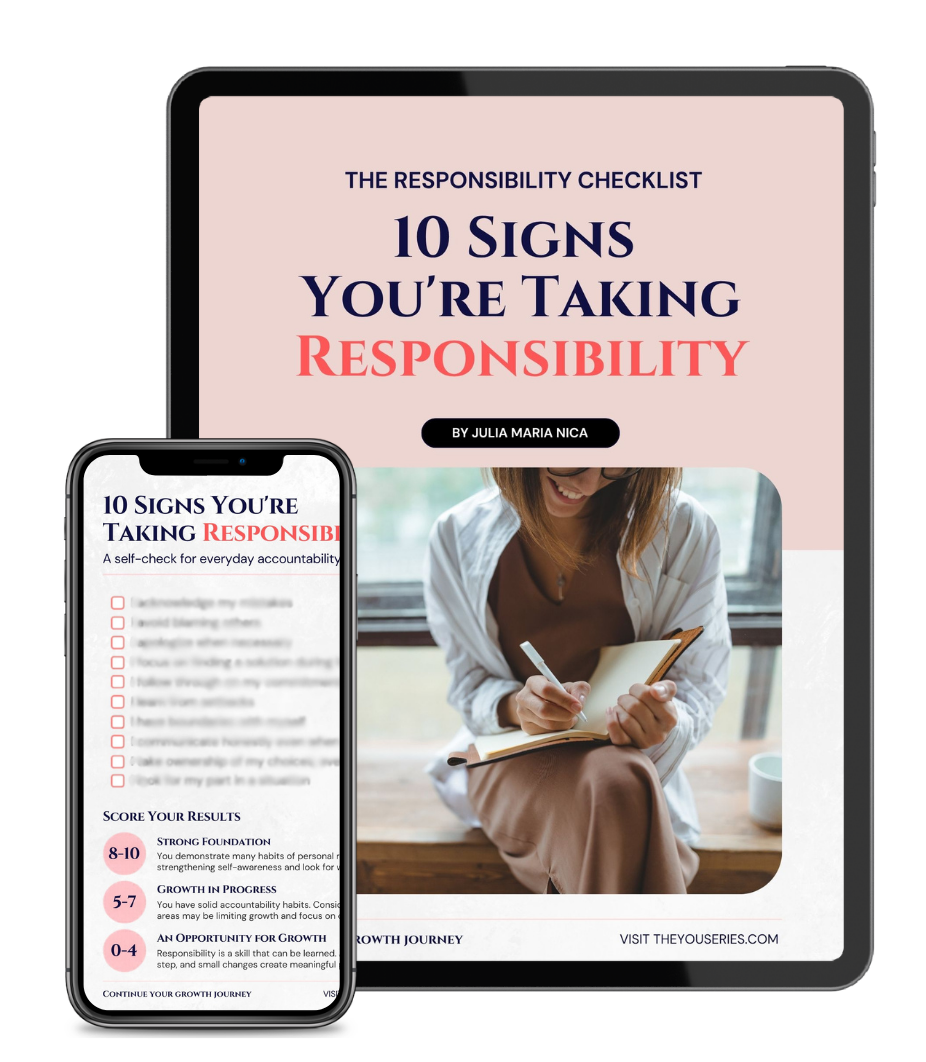
Grab your free checklist
The "10 Signs You're
Taking Responsibility" Checklist!
Choose one small action to strengthen your personal responsibility.
Why Start Taking Responsibility?
Is taking responsibility the power move you need?
If you’re ready to step into their power. Then learning everything you can about taking responsibility is what you should focus on. Take a good look at yourself and who you’ve been showing up as. Look back at how you’ve reacted to hard situations in your life. Learn from the time’s you’ve chosen to blame other circumstances or people. Begin to discover the level of responsibility you can take in your life and raise that bar for yourself.
Let’s break down responsibility from the beginning…
- Firstly, it starts with your thoughts, every single thought you have creates some kind of emotion.
- Secondly, once your thoughts turn into emotions. Those emotions show on your face & way of being.
- Further, those thoughts & emotions become transformed through your words and into actions you take.
- Lastly, those thoughts, emotions, words, and actions are all 100% your responsibility… regardless of what other people say or do.
As a result of FULL taking responsibility, you’ll feel:
- Power: You’ll begin to experience a new type of power in your life.
- Control: You will feel like you have control over yourself. You are the only person or thing in this world that you can control. The only power we have over other people is through influence. Influence is freeing and lets others choose their path.
- Creation: You’ll begin to notice that what you can create is unlimited.
- Clarity: You will be able to define and recognize a whole new reality in your life.
- New Direction: You’ll be able to guide your direction in life through intention.
Are you new here?
I also have the following content that focuses on helping you get out of your way, build confidence & guide you toward taking effortless action…
Create A Better Relationships With Yourself:
- What Are Core Values? Essential Guide to Clarity & confidence
- A Complete Guide on How to Start Taking Responsibility
- How to Start Accepting Responsibility for Your Actions (28 Examples)
- What Is Self-Love? A Complete Guide to Improving It
- The Key to Self-Awareness: Boost Confidence and Relationships
Build More Confidence:
- Self-Confidence: Unleashing the Power Within You
- Self-Trust Tips: Simple Ways to Increase Your Confidence Daily
- Feeling Confident: The Ultimate Guide to Embracing Who You Are
Build Better Relationships:
- How to Be More Confident in Relationships
- 7 Steps To Having A Happy Relationship That Brings You Joy
- Reasons Why You Should Start Judging People: (A Shift on How You View Judgement)
Dreams & Intentions:
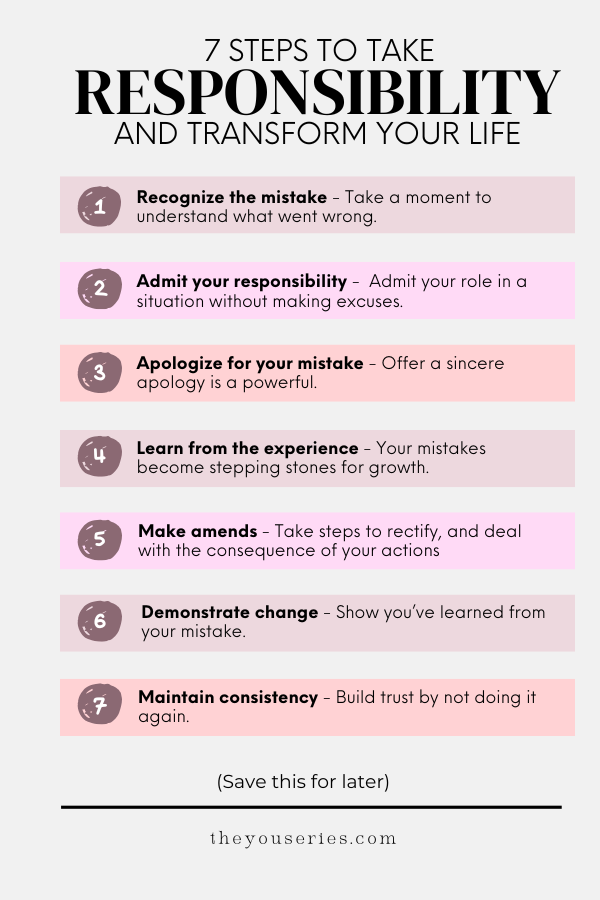
7 Steps to Taking Responsibility in Your Life:
Now, let’s explore the concrete steps one can take to embrace responsibility:
1. Recognize the mistake:
Firstly, acknowledging our errors is the initial step towards responsibility. Taking a moment to understand what went wrong provides valuable insight into areas for improvement.
Have the self-awareness to notice what you could have done better & own where you stepped out of alignment.
2. Admit responsibility:
Ownership is key. Admitting our role in a situation without making excuses demonstrates integrity and a commitment to accountability.
3. Apologize:
Offering a sincere apology is a powerful way to bridge gaps caused by our actions. It shows empathy and a willingness to make amends. Have a conversation with the people that are involved.
Having a conversation with the people involved will help you and they feel complete about what happened.
This is so important because it will clean up your “Karma” and “Integrity”. Integrity is so important when it comes to being successful in life, you don’t want a community of people upset with you or gossiping about you, saying things like “Oh they don’t take any responsibility.
4. Learn from the experience:
Moving forward, mistakes become stepping stones for growth when we take the time to understand their root causes. Learning from experiences is an integral part of the responsibility journey.
5. Make amends:
Responsibility involves more than words; it requires action. Taking steps to rectify or mitigate the consequences of our actions is a tangible way to demonstrate commitment to change.
6. Demonstrate change:
Consistency is key. Integrating lessons learned into our behavior and making positive choices over time reinforces the sincerity of our commitment to responsibility.
7. Maintain consistency:
Long-term responsibility involves a commitment to being reliable. Building trust requires ongoing effort, and maintaining consistency in our actions is fundamental to this process.
Reflect, Extract Your Lesson
Make sure to reflect:
Where were you out of alignment? (To fully understand alignment, you must do core value work.) What is being in alignment for you? Your values and standards, considering other people’s values and standards. Have the self-awareness to notice what you could have done better and own where you stepped out of alignment. Pinpoint where you need to take responsibility.
Taking a journey back to what had happened is encouraged if you don’t hang out in the past. Always look for solutions & healing. Learn from past mistakes. Turn all of your “should haves” into new actions in the present moment.
Extract your lesson:
In every situation that presents a challenge for you, there is always a lesson that you can extract. This will prevent you from going in loops in your life. Always making the same mistake, never learning from your mistakes, and creating the same result again and again in your life.
Set an intention for the future:
Prepare for a new step. Create intentions for a new direction in the future. Get super clear about what you want to see happen in the situation that you’re experiencing.
Do some research, and learn about how you can apologize, communicate, and discuss solutions with the people involved.
How To Apologize Once You've Taken Responsibility:
Apologies can vary based on the nature of the situation, but they generally share common elements such as acknowledging responsibility, expressing remorse, and outlining steps for improvement or restitution.
Here are some examples of apologies that reflect taking responsibility:
1. Simple apology example:
“I want to sincerely apologize for my actions and I take full responsibility for [specific behavior]. I understand the impact it had on you. I’m truly sorry.”
2. Acknowledging mistake example:
“I realize that I made a mistake, and I want to own up to it. I’m responsible for [describe the mistake], and I apologize for any inconvenience or hurt it may have caused.”
3. Expressing regret example:
“I deeply regret my actions and want to take full responsibility for them. I understand the hurt and frustration I may have caused, and I want you to know that I am truly sorry.”
4. Committing to change example:
“I acknowledge my responsibility in [the situation]. I want you to know that I am committed to making positive changes. I’ll [describe specific actions or changes] to ensure this doesn’t happen again.”
5. Understanding impact example:
“I want to apologize for my behavior and take full responsibility for it. I now realize the impact it had on you, and I am truly sorry. Moving forward, I am committed to [action or change].”
6. Empathetic apology example:
“I understand how my actions may have hurt you, and I want to sincerely apologize for that. I take full responsibility and want you to know that I empathize with your feelings.”
7. Making amends example:
“I take responsibility for [specific actions] and recognize the harm it caused. I’m am committed to making amends and will [outline steps or actions] to rectify the situation.”
Remember that a genuine apology not only acknowledges responsibility but also demonstrates a sincere intention to learn from the mistake and make positive changes.
It’s important to be specific, express empathy, and follow through on any commitments made during the apology.
Building Trust Through Responsibility:
Taking responsibility isn’t just about growing, it’s also key to building trust with others. When we’re accountable for our actions, clear about our intentions, and respectful of boundaries. We show that we can be counted on. People trust us more because they know we’ll follow through. By consistently living according to our core values, we create a reputation for integrity, strengthening our personal and professional relationships.
Behaviors that Build Trust:
- Consistency: Following through on promises shows dependability.
- Accountability: Owning up to mistakes builds credibility.
- Integrity: Acting by strong moral principles and guided by core values, even when no one is watching. This builds trust and reinforces reliability.
- Clear Communication: Being open and honest creates security.
- Respecting Boundaries: Acknowledging and honoring others’ limits fosters mutual respect.
- Emotional Awareness: Managing emotions with maturity reassures others of your stability.
- Resolution: Actively seeking solutions and resolving conflicts shows commitment to moving forward.
Behaviors that Break Trust:
- Inconsistency: Failing to follow through causes doubt.
- Avoiding Accountability: Blaming others undermines trust.
- Lack of Integrity: Acting in ways that are dishonest or self-serving damages credibility and causes others to question your intentions. Often not having any values that are followed.
- Poor Communication: Withholding or misleading information creates confusion.
- Disrespecting Boundaries: Ignoring others’ needs damages respect.
- Emotional Instability: Reacting impulsively creates insecurity in relationships.
- Avoiding Resolution: Letting conflicts fester without seeking resolution leads to unresolved issues and weakened trust.
Let’s look at trust in action, I always find that real-life examples help me see the difference in a situation. So here are some trust-in-action examples.
Consistency VS. Inconsistency:
Consistency Example: A colleague always meets deadlines and keeps their word on team tasks, so others know they can rely on them.
Inconsistency Example: A coworker promises to help but repeatedly cancels at the last minute, making others question their reliability.
Accountability VS. Avoiding Accountability
Accountability Example: A manager admits when they make a mistake and works to correct it, showing they are trustworthy and responsible.
Avoiding Accountability Example: A colleague blames others for a failed project without admitting their own mistakes, creating distrust.
Clear Communication VS. Poor Communication
Clear Communication Example: A partner openly shares their plans, making sure you know what’s going on, so you’re never left wondering.
Poor Communication Example: A partner withholds important details about their plans, leaving you confused and anxious.
Respecting Boundaries VS. Disrespecting Boundaries
Respecting Boundaries Example: A friend listens and honors your need for space, showing they value your limits.
Disrespecting Boundaries Example: A friend pushes you to go out when you’ve expressed needing time alone, showing disregard for your needs.
Emotional Awareness VS. Emotional Instability
Emotional Awareness Example: During a heated discussion, someone stays calm and listens, ensuring a productive conversation rather than escalating tension. This shows they are observing the emotions in the room and keeping their own in check.
Emotional Instability Example: Someone frequently lashes out in emotional outbursts, leaving others feeling uncertain about how to interact with them.
Resolution VS. Avoiding Resolution
Resolution Example: After an argument, a team member works with others to resolve the issue, focusing on finding solutions instead of dwelling on the problem.
Avoiding Resolution Example: A family member avoids talking about a problem, letting it linger and causing tension within the group. This creates a toxic family dynamic.
Integrity VS. Lack of Integrity
Integrity Example: Someone consistently acts with honesty and fairness, even when no one is around to see, making them someone you can count on.
Lack of Integrity Example: A person lies or takes shortcuts to benefit themselves, causing others to lose trust in their words and actions.
Dealing with Irresponsibility in Relationships
Transitioning to dealing with irresponsibility in relationships, it’s essential to set clear expectations, express concerns, and provide support where possible. However, if efforts to address the issue prove not to work out for you and the relationship poses harm or too much stress in your life, it might be necessary to evaluate and, if necessary, step away.
Dealing with irresponsibility in relationships can be challenging, but it’s essential to address the issue constructively. Here are some steps to help navigate through such situations:
1. Reflect on the impact:
Take a moment to assess how the irresponsibility is affecting the relationship. Consider both the emotional and practical implications of the behavior. Understanding the impact is crucial before addressing the issue.
2. Communicate openly:
Initiate an honest and open conversation about the observed irresponsibility. Use “I” statements to express your feelings and observations, focusing on the behavior rather than making personal attacks. Create a safe space for the other person to share their perspective as well.
3. Set clear boundaries:
Clearly articulate what your boundaries are regarding responsibilities and commitments in the relationship. Be specific about what actions or changes are needed to address the issue. Establishing clarity helps in avoiding misunderstandings.
4. Express concerns tactfully:
While addressing the problem, choose your words carefully to avoid sounding accusatory. Express your concerns tactfully, emphasizing that your intention is to strengthen the relationship rather than criticize.
5. Provide constructive feedback:
Offer feedback that is constructive and solution-oriented. Instead of dwelling solely on the problem, discuss potential solutions or compromises that could improve the situation. Collaborative problem-solving can foster a sense of shared responsibility.
6. Offer support:
This means that you need to be self-aware and have some empathy for the other person. Sometimes, when someone is not taking responsibility, it may stem from external factors such as stress or overwhelm. Offer your support and ask if there’s anything you can do to help. Demonstrating understanding and empathy can create a supportive environment.
7. Establish consequences:
Clearly outline the potential consequences of continued irresponsibility. This step is not meant to be punitive but rather to emphasize the importance of accountability. It provides a framework for understanding the gravity of the situation.
8. Reassess and adjust expectations:
Be open to reassessing and adjusting expectations based on the discussion. Sometimes, a compromise or a gradual adjustment in responsibilities can be a more realistic approach.
9. Seek professional guidance:
If the irresponsibility persists and significantly impacts the relationship, consider seeking the assistance of a relationship counselor, life coach or therapist. Professional guidance can provide additional insights and strategies for addressing the issue.
10 Evaluate the relationship:
After taking steps to address the irresponsibility, evaluate the overall health of the relationship. Assess whether the changes are sustainable and whether both parties are genuinely committed to making improvements. If necessary, be prepared to make difficult decisions regarding the future of the relationship.
Remember, every relationship is unique, and these steps may need to be adapted based on the specific dynamics and individuals involved. Open communication and a willingness to work together are essential components of addressing irresponsibility in relationships.

✨ Ready to Dive Deeper?
The Personality Style Toolkit — $19 (Normally $39)
Discover more about yourself and others with this Toolkit!
The Cookie Crumb Analogy:
 This is how I find what I’m responsible for in life. It’s the easiest way I could break down how your 100% responsible for your life.
The cookie:
- You’re the cookie.
The crumbs represent:
- The things you think about.
- The emotions you feel.
- The words you speak.
- The actions you take.
As you go through life you creating results you leave these crumbs behind. They form a path behind you. They are proof of how you’re responsible for everything in your life.
In hindsight, those crumbs give you a lot of insight about what you’re accountable for. They also show you a clear path to what and how you’ve created your results in your life.
Reflect on your crumbs:
Taking a look back & reflecting on the crumbs that you’ve created will give you powerful insight on how you show up in life. They will also show you what new actions you can take in the future.
Responsibility Builds Self-Awareness
Taking responsibility is key to self-awareness and healthy relationships. It begins with recognizing your needs and limitations. Being honest with yourself and others about what you require to feel supported, safe, and grounded. Communicating openly and managing your reactions calmly shows maturity and emotional control. Especially in moments of tension or conflict.
Responsibility means avoiding blame:
Instead of pointing fingers, you look inward and ask,
What can I take ownership of?
What am I in control of?
This mindset builds confidence, self-respect, and trust in your ability to handle challenges with integrity.
Life becomes easier when you pair… self-awareness with responsibility. – Julia Maria Nica
As you become more attuned to your triggers, patterns, and the adjustments you need to make over time.
Self-awareness is a core part of being a healthy, emotionally grounded person. It’s what allows you to pause, reflect, and understand what’s really going on inside of you. Your needs, your feelings, and your patterns. But it also extends outward.
This inner awareness helps you put yourself in other people’s shoes. Recognize when you’ve overstepped, and take responsibility when you’ve hurt someone. Some people move through life completely disconnected from how their actions affect others. Unaware of the emotional tone in the room or the impact they’re having.
When you’re self-aware, not only of your own experience but the experience of others. It creates deeper connection, trust, and emotional integrity in relationships.
The power of being self-aware is limitless it helps you navigate relationships, grow through challenges, lead with emotional intelligence at work, and stay aligned in the pursuit of your dreams.
Here is what you will find becomes natural:
- Owning and knowing what your needs are
- Having the ability to communicate your needs and feelings clearly
- Managing your reactions and emotions, acting proactively
- Avoiding blaming others and looking at what you can do better, what you’re in control of
- Taking accountability for your actions and the energy you bring into situations
- Being present and supportive during problem-solving conversations
- Valuing mutual respect and emotional honesty in relationships
- Encouraging growth, reflection, and responsibility in yourself and those around you
Cultivating Responsibility in Your Daily Life:
Shifting our focus to practical tips for day-to-day life, consider implementing the following strategies:
Keep causes of irresponsibility in check:
- Always check in to make sure that you’re not blaming other people for things that you should be looking into for yourself.
Commitments:
- Set clear goals and priorities to guide your actions.
- Create and stick to a schedule, fostering consistency.
- Break down tasks into manageable steps for easier execution.
Be Organized:
- Establish routines for key activities, providing structure.
- Stay organized in your living and working spaces to reduce stress.
- Learn to say no when needed, ensuring realistic commitments.
Reflect:
- Reflect regularly on your actions and decisions for continuous improvement.
Get support:
- Embrace accountability partners for mutual support.
- Talk to somebody for support and accountability. (Counsellor, Therapist, Life Coach)
In Conclusion
In conclusion, responsibility is not just a set of actions; it’s a mindset and a way of life. By embracing responsibility and understanding it’s difference to accountability.
You pave the way for personal growth, building stronger relationships, and living a more fulfilling life.
Ready to take ownership and step into your full potential?
Take the first step toward your transformation!
Taking responsibility helps you take control to make positive changes in your life. If you’re ready to live more intentionally and confidently, get started below! Together, we’ll build the clarity and self-awareness needed for lasting transformation.

Julia Maria Nica
Build Confidence Coach
Julia grew up in Vancouver, B.C. She immigrated from Romania to Canada in the ’90s with her family. Julia decided to find her passion. Just like many women, she experienced her own self-image challenges. She came up with the idea of The YOU Series as a part of unraveling the pain of her life. Today she focuses on building The You Series, coaching her clients, and creating new content.
Connect With Julia:





Read More Articles Written By Julia:

What Does a Life Coach Actually Help With?
Why Saying No Feels So Hard (And How to Stop Feeling Guilty)

What Are Core Values? Essential Guide to Clarity & confidence






 Grab It for $19